
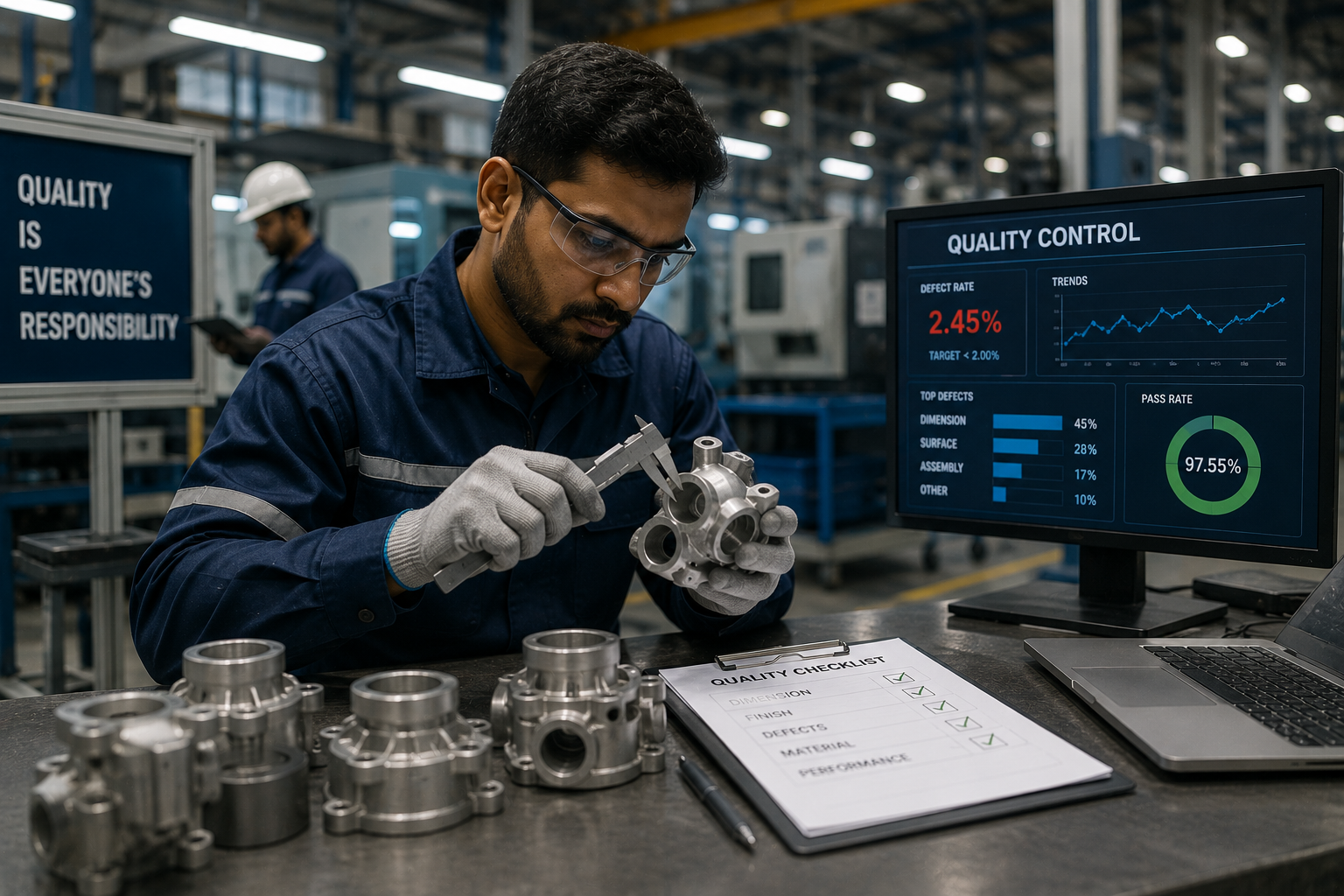
Meeting consistent quality standards is one of the biggest challenges for Indian manufacturers. Whether supplying to domestic OEMs or exporting to global markets, companies are under constant pressure to deliver defect-free products while controlling costs and maintaining speed. Many factories still struggle with high rejection rates, customer complaints, rework, and audit non-conformance. Traditional quality systems that rely heavily on manual inspection and end-of-line checks often detect problems too late — after material and time have already been wasted.
Intelligent tools powered by AI, machine vision, IoT, and advanced analytics are helping manufacturers shift from reactive quality control to proactive quality assurance. This is a core focus under the Quality & Inspection track.
Here are the common difficulties in meeting quality standards and 5 practical ways intelligent tools can help overcome them.
Common Difficulties in Meeting Quality Standards
● Inconsistent incoming raw material quality
● High dependence on manual inspection (prone to fatigue and human error)
● Process variations that go undetected in real time
● Poor traceability from raw material to finished goods
● Delayed detection of defects leading to high scrap and rework
● Difficulty in maintaining consistency across shifts and operators
● Challenges in meeting stringent customer and international standards (IATF, ISO,FDA, etc.)
● Weak root cause analysis and recurring quality issues
These problems are especially common in high-volume and multi-stage manufacturing environments.
5 Ways Intelligent Tools Can Help
- AI-Powered Visual Inspection and Defect Detection
Machine vision systems combined with AI can inspect products at high speed with far greater consistency than human inspectors.
Benefits:
● Detect surface defects, dimensional errors, and assembly issues with high accuracy
● Operate 24/7 without fatigue
● Reduce dependency on manual final inspection
● Lower customer complaints and returns
- Real-Time Process Monitoring and Control
IoT sensors and intelligent platforms continuously track critical process parameters (temperature, pressure, speed, humidity, etc.) and alert teams the moment values drift outside acceptable limits.
Impact:
● Prevent defects before they occur
● Reduce process variation
● Improve first-pass yield
● Enable data-driven process adjustments
- Predictive Quality Analytics
Instead of waiting for defects to appear, AI models analyse historical and live data to predict the likelihood of quality failures.
Advantages:
● Early warning of potential quality issues
● Focused attention on high-risk batches or machines
● Reduced scrap and rework
● Better planning of quality resources
- End-to-End Digital Traceability
Intelligent systems create a digital record of every stage — from supplier material to final product — making it easy to track and verify quality.
Key Benefits:
● Faster root cause analysis during quality issues
● Stronger supplier quality management
● Easier compliance during customer and regulatory audits
● Improved recall readiness (if ever required)
- Automated Data Collection and Intelligent Root Cause Analysis
Smart quality management systems automatically capture inspection and process data and use AI to identify patterns and root causes.
Results:
● Faster and more accurate Corrective and Preventive Actions (CAP)
● Reduction in recurring defects
● Continuous quality improvement culture
● Knowledge retention across shifts and plants
Conclusion
Meeting quality standards consistently is no longer just about more inspectors or stricter checks. It requires intelligent systems that can detect, predict, and prevent quality issues in real time. Indian manufacturers who adopt these tools gain higher customer confidence, lower quality costs, and stronger competitiveness in both domestic and export markets. manAIhub supports Quality Heads, Plant Leaders, and Engineers with practical insights, real-world use cases, and connections to proven solutions under the Quality & Inspection track.
Ready to Strengthen Your Quality Performance?
Start by identifying your highest rejection or customer complaint areas and explore intelligent tools that can deliver measurable improvement.
What is the biggest difficulty you face in meeting quality standards?
Share your challenges in the comments or join the manAIhub community to learn from other manufacturing professionals.