Transformation Enablers: The Tools to Lead the Human Side of AI
Most AI programmes in Indian manufacturing don't fail because the algorithm was wrong. They fail because the organisation wasn't ready.
ManAIhub Transformation Enablers include a complete cross-plant rollout playbook covering
Site prioritisation methodology
How to sequence which plants to deploy AI to next, based on data readiness, leadership alignment, operational similarity to the pilot site, and strategic importance
Standardisation versus localisation decisions
Which elements of the AI programme need to be consistent across all plants, and which need to be adapted for local operating conditions, systems, and culture
Local leadership enablement
How to build the plant-level capability and ownership required for AI to be successfully adopted at each site, rather than being imposed from the centre
Handling digital maturity gaps
A structured approach for bringing plants with older systems and lower data infrastructure up to the baseline required for AI deployment, without creating a two-tier organisation
Rollout sequencing and change management
The week-by-week implementation sequence for each plant, including communication milestones, training delivery, go-live criteria, and stabilisation period management
Network-wide performance tracking
How to monitor AI programme performance consistently across multiple plants with different contexts, and how to use cross-plant data to continuously improve the programme
Where AI doesn't pay off (yet) — and why
Not change management theory. Practitioner-built tools for Indian manufacturing.
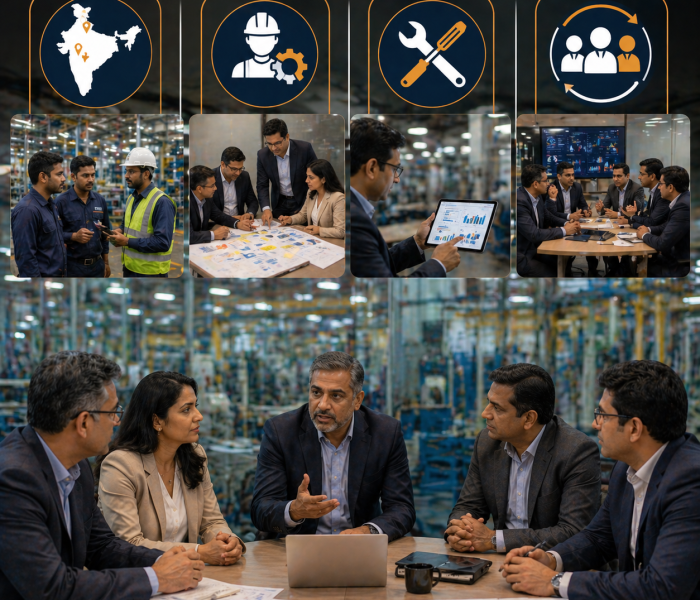
India-specific, not imported
Workforce dynamics, union relationships, multi-generational plant cultures, and the specific constraints of Indian industrial infrastructure make transformation in Indian manufacturing genuinely different from global benchmarks.
Built from implementation reality, not best practice theory
The frameworks, templates, and roadmaps in ManAIhub Transformation Enablers are built from real implementation experiences — including the difficult ones.
Immediately usable, not conceptual
Every tool is designed to be used directly — by your leadership team, your HR function, your plant managers, or your change management leads.
Continuously updated by the community
ManAIhub Transformation Enablers are not a static library.
frequently asked question
Culture Change and AI Readiness Frameworks
The single most underestimated factor in AI adoption is organisational culture — and in Indian manufacturing, where many plants have deep-rooted working practices, generational workforces, and strong union presence, it is also the most consequential.
ManAIhub Transformation Enablers include practical frameworks for:
Assessing your organisation’s AI readiness — not just data infrastructure, but leadership alignment, change appetite, cross-functional trust, and the degree to which your teams believe AI is being done with them, not to them
Building a culture of data trust — the specific steps that shift floor-level behaviour from ignoring analytics dashboards to acting on them consistently
Communicating AI to frontline workers — what to say, what not to say, and how to have the job security conversation honestly and proactively without creating the fear that kills adoption before it starts
Creating psychological safety around AI — so that workers report when AI recommendations look wrong, rather than silently overriding them or following them blindly
These frameworks are built from the real experiences of manufacturing leaders who have navigated cultural resistance on Indian shop floors — not adapted from change management theory developed in other industries and geographies.
Workforce Reskilling Roadmaps
AI does not eliminate the need for skilled people in manufacturing. It changes what those skills need to be. The organisations that scale AI successfully are the ones that invest in reskilling in parallel with deployment — not as an afterthought once resistance emerges.
ManAIhub provides structured roadmaps for:
Identifying which roles need to evolve — a role-by-role analysis across maintenance, quality, production, supply chain, and operations functions, mapping current responsibilities against what AI handles and what new capabilities people in those roles need to develop
Deciding what to build internally versus source externally — a framework for assessing which AI skills can realistically be developed within your existing workforce, which require targeted external hiring, and which are best managed through partnerships
Designing reskilling programmes that work in a manufacturing environment — shift-compatible learning formats, on-the-job capability building, and mentoring structures that don’t require pulling people off the line to attend classroom training
Tracking workforce capability as an AI programme metric — so that reskilling is treated as a programme deliverable with clear milestones, not a soft initiative that runs alongside the real work
Operating Model Redesign Frameworks
Deploying AI into a plant without redesigning the operating model around it is one of the most common and costly mistakes in manufacturing AI programmes. The AI makes a recommendation. Nobody is sure who acts on it. The existing process doesn’t account for it. It gets ignored.
ManAIhub Transformation Enablers include frameworks for:
Redefining roles and decision rights — how do the responsibilities of plant managers, quality heads, maintenance engineers, and supply chain planners change when AI is embedded into their workflows? What decisions does AI support versus which ones remain fully human?
Redesigning workflows around AI outputs — the specific process changes required for each of the six ManAIhub focus tracks, so AI recommendations are integrated into daily operations rather than sitting alongside them
Structuring cross-functional accountability — how to resolve the IT-versus-Operations tension that derails most AI programmes, and build shared ownership of AI initiatives across functions that historically operate in silos
Managing the transition period — the operational model for running human and AI decision-making in parallel during deployment, and how to transition accountability progressively as confidence and capability build