
Why Quality Inspection Needs a New Approach
Quality has always been a cornerstone of manufacturing success. Whether producing automotive components, pharmaceuticals, consumer goods, electronics, or industrial equipment, manufacturers depend on consistent quality to maintain customer trust and remain competitive.
Yet quality inspection remains a challenge for many Indian factories.
Traditional inspection processes often rely heavily on manual checks, operator experience, and sample-based inspections. While these methods have served manufacturers for decades, they can struggle to keep pace with increasing production volumes, tighter quality standards, and customer expectations for near-zero defects.
As manufacturers embrace Industry 4.0, Artificial Intelligence (AI) is emerging as a powerful tool to transform quality inspection from a reactive activity into a proactive and intelligent process.
The question is no longer whether AI can improve quality inspection.
The question is how manufacturers can practically implement it.
The Hidden Cost of Quality Issues
When defects escape detection, the consequences can be significant:
- Customer complaints and returns
- Rework and scrap costs
- Production delays
- Warranty claims
- Brand reputation damage
- Regulatory compliance risks
- Reduced profitability
Even small improvements in defect detection can generate substantial business value across a manufacturing operation.
This is why leading manufacturers are increasingly investing in AI-powered quality systems.
Step 1: Identify High-Impact Quality Problems
The first step is to focus on quality challenges that create the greatest business impact.
Instead of attempting to automate every inspection process, prioritize areas such as:
- High defect rates
- Frequent customer complaints
- Manual inspection bottlenecks
- Safety-critical components
- High-value products
- Processes with significant rework costs
Examples include:
- Surface defect detection
- Weld inspection
- Assembly verification
- Packaging inspection
- Dimensional accuracy checks
- Paint and coating quality assessment
Starting with a high-value use case increases the likelihood of measurable results and organizational support.
Step 2: Digitize Inspection Data
AI requires data to learn and improve.
Unfortunately, many quality processes still depend on paper records, spreadsheets, and fragmented systems.
Manufacturers should begin by digitizing:
- Inspection reports
- Defect logs
- Quality measurements
- Production parameters
- Customer complaint records
- Process deviation reports
Creating a centralized quality data foundation enables better analysis and supports future AI initiatives.
The more structured and reliable the data, the more effective AI models become.
Step 3: Deploy AI-Powered Visual Inspection
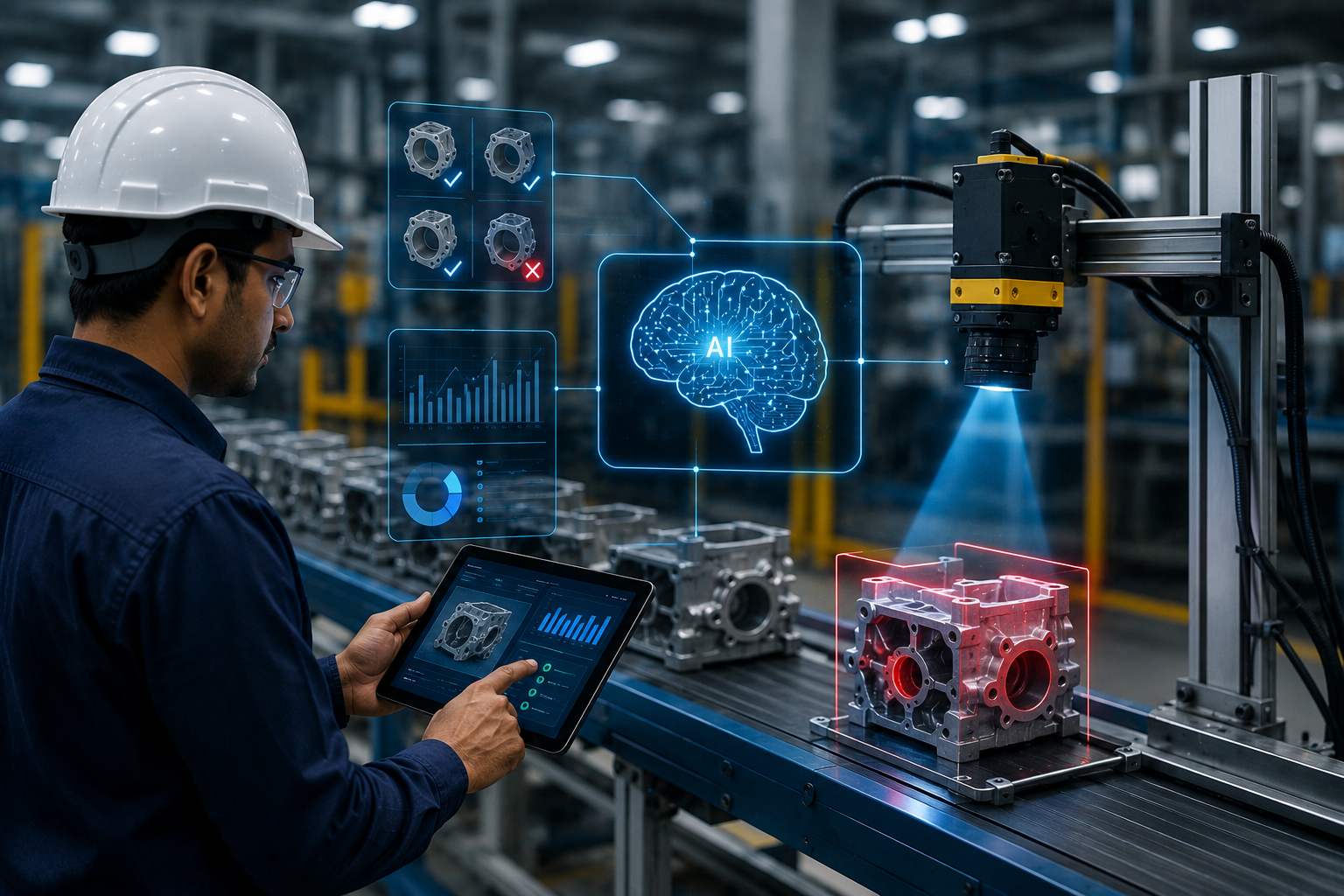
One of the most successful AI applications in manufacturing is computer vision.
AI vision systems use cameras and machine learning algorithms to automatically inspect products in real time.
These systems can detect:
- Surface scratches
- Cracks and dents
- Missing components
- Incorrect assembly
- Dimensional deviations
- Packaging defects
- Labeling errors
Unlike manual inspection, AI-powered vision systems can operate continuously, maintain consistent standards, and inspect every product rather than relying on random sampling.
Benefits often include:
- Higher defect detection accuracy
- Reduced inspection time
- Lower labor dependency
- Improved consistency across shifts
- Faster root cause identification
For many manufacturers, computer vision delivers one of the fastest returns on AI investment.
Step 4: Use AI to Predict Quality Issues Before They Occur
Traditional quality systems focus on identifying defects after production.
AI enables manufacturers to predict quality problems before defective products are produced.
By analyzing relationships between:
- Machine settings
- Process parameters
- Environmental conditions
- Production data
- Historical defect patterns
AI models can identify conditions that increase the likelihood of defects.
For example:
- Temperature variations may predict coating defects.
- Tool wear may indicate future dimensional issues.
- Process instability may signal increased rejection rates.
Instead of detecting defects after they occur, manufacturers can proactively adjust processes to prevent them.
This shift from detection to prevention creates significant operational and financial benefits.
Step 5: Create a Closed-Loop Quality Improvement System
Technology alone will not improve quality.
The most successful manufacturers combine AI insights with continuous improvement practices.
A closed-loop quality system should include:
- Real-time defect monitoring
- Automated alerts
- Root cause analysis
- Corrective action workflows
- Performance dashboards
- Continuous model improvement
Quality teams, production teams, and maintenance teams should collaborate using shared insights from AI systems.
This creates a culture where quality improvement becomes an ongoing process rather than a periodic initiative.
The objective is not simply to identify defects faster.
The objective is to reduce defects altogether.
Common Challenges When Implementing AI Quality Inspection
While AI offers significant potential, manufacturers should be aware of common obstacles:
Poor Data Quality
Incomplete or inconsistent data can limit AI effectiveness.
Insufficient Image Samples
Computer vision models require a diverse set of defect and non-defect images for training.
Change Management Resistance
Operators may initially view AI as a replacement rather than a support tool.
Lack of Standardized Processes
AI performs best when inspection criteria and quality standards are clearly defined.
Addressing these challenges early improves the chances of successful implementation.
Why AI Quality Inspection Matters for Indian Manufacturing
Indian manufacturers are increasingly competing in global markets where quality expectations continue to rise.
Customers expect:
- Faster delivery
- Higher consistency
- Lower defect rates
- Greater traceability
AI-powered quality inspection helps manufacturers meet these expectations while improving productivity and reducing costs.
As technologies become more affordable and accessible, AI is no longer limited to large enterprises. Mid-sized and growing manufacturers can now adopt AI-driven quality solutions to strengthen their competitive position.
Final Thoughts
Quality inspection is evolving from manual observation to intelligent decision-making.
Manufacturers that embrace AI can move beyond simply finding defects and begin preventing them altogether.
By focusing on high-impact quality challenges, digitizing inspection data, implementing AI vision systems, predicting quality issues, and building closed-loop improvement processes, Indian manufacturers can significantly improve product quality and operational performance.
The future of manufacturing quality is not just faster inspection.
It is smarter inspection powered by data, intelligence, and continuous learning.
Organizations that adopt this approach today will be better positioned to meet tomorrow’s quality expectations and compete successfully in an increasingly demanding global market.